
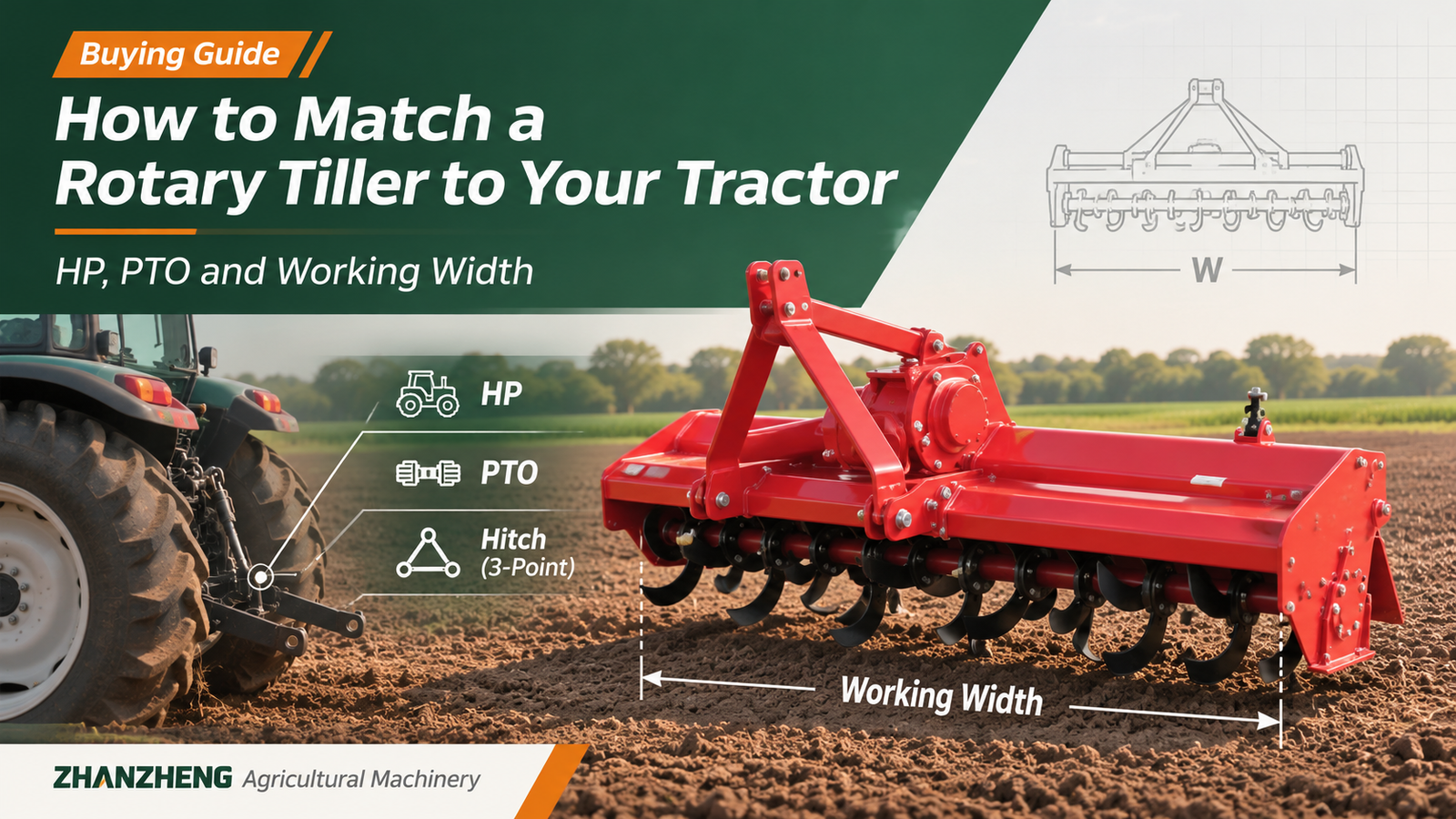
Choosing the right rotary tiller is about more than selecting an implement that looks suitable for your tractor.
The tractor and tiller must work together as a compatible system. Engine horsepower, available PTO power, PTO shaft connections, three-point hitch specifications, working width and operating conditions all influence the selection.
For agricultural machinery importers, distributors and farm equipment buyers, checking these details before ordering can help prevent compatibility problems and unnecessary costs.
This guide explains the main factors to consider when matching a tractor-mounted rotary tiller to an agricultural tractor, using the ZHANZHENG 1GQN-180 as a practical product example.
1. What Should You Check Before Buying a Rotary Tiller?
A rotary tiller is a soil preparation implement that uses rotating blades to break up and cultivate soil.
Many tractor-mounted models receive mechanical power through the tractor's power take-off (PTO) system.
Before purchasing a tiller, buyers should verify five essential factors:
- Tractor horsepower and the implement's power requirements.
- PTO operating speed, shaft connection and driveline compatibility.
- Working width and the intended field conditions.
- Three-point hitch dimensions and lifting capacity.
- Implement weight, transmission arrangement and operating requirements.
A suitable horsepower rating alone does not guarantee that a tractor and rotary tiller are compatible.
2. How Much Tractor Horsepower Does a Rotary Tiller Need?
Tractor horsepower is one of the first specifications buyers compare.
However, the correct power range depends on the tiller's design, working width, gearbox, blades and intended operating conditions.
Engine Horsepower vs. PTO Horsepower
Engine horsepower measures the engine's rated output.
PTO horsepower describes the power available through the tractor's PTO system.
These values are not identical.
When selecting a PTO-driven tiller, buyers should confirm whether the implement's stated power requirement refers to engine horsepower or PTO horsepower.
Why Soil Conditions Matter
Different soil conditions can place different demands on tillage equipment.
Factors worth considering include:
- Soil texture and compaction.
- Existing crop residues.
- Soil moisture.
- Intended tillage depth.
- Working speed and number of passes.
The correct implement must be selected within its approved operating limits.
Buying tip: Ask for the implement's recommended tractor power range and the tractor's actual PTO specifications before confirming compatibility.
3. PTO Speed and Shaft Compatibility
The PTO system transfers mechanical power from the tractor to the implement.
This makes PTO compatibility an essential part of rotary tiller selection.
PTO Operating Speed
Agricultural tractors and implements may use different PTO speed arrangements.
For example, 540 rpm and 1,000 rpm are common agricultural PTO operating speeds, but individual machines have specific requirements.
The tractor must provide the operating speed required by the selected tiller.
Do not assume that a rotary tiller can operate at every PTO speed available on a tractor.
PTO Shaft and Connection
Buyers should also confirm:
- PTO shaft spline type.
- Required operating speed.
- Implement input connection.
- Driveline length and operating clearance.
- Compatible protective guards.
- Any required overload protection.
Incorrect shaft or driveline selection can cause equipment damage and create serious safety hazards.
Important: Follow the actual tractor and implement manuals. Never operate an implement at an unapproved PTO speed.
4. How to Choose the Right Rotary Tiller Working Width
Working width determines the nominal width of soil covered during a tillage pass.
It also influences implement selection and compatibility with the tractor.
A wider tiller can cover more ground per pass, but it may require additional power and place greater demands on the tractor.
A narrower tiller may be easier to use where access or turning space is limited.
Working Width vs. Tractor Width
Buyers should compare the tiller's working width with the tractor's rear tyre track and overall configuration.
Depending on the application, sufficient coverage behind the tractor may be desirable.
However, working width should not be increased beyond the power and mechanical limits recommended for the implement.
Example: 1,650 mm Working Width
A tiller with a 1,650 mm working width has a nominal working width of 1.65 metres.
This does not automatically mean it is suitable for every tractor with a similar overall width.
The selected tractor's horsepower, PTO system, hitch arrangement and operating conditions must also be considered.
5. Three-Point Hitch and Linkage Compatibility
The three-point hitch connects many mounted agricultural implements to the tractor.
Before ordering a rotary tiller, check:
- Tractor hitch category.
- Implement mounting dimensions.
- Lower-link and top-link connection requirements.
- Tractor lifting capacity.
- Implement operating weight.
- PTO driveline clearance through the approved lifting range.
Hitch categories and mounting dimensions are not interchangeable without appropriate, approved equipment.
The tractor must also be able to lift and transport the implement safely.
For international buyers, receiving the correct connection specifications is especially important because tractors and implements may be sourced separately.
6. Product Example: ZHANZHENG 1GQN-180 Rotary Tiller
The ZHANZHENG 1GQN-180 is a tractor-mounted rotary tiller listed within the 1GQN agricultural implement series.
Its available product specifications include:
| Specification | Listed Value |
|---|---|
| Model | 1GQN-180 |
| Equipment type | Tractor-mounted rotary tiller |
| Matched tractor power | 50–60 HP |
| Working width | 1,650 mm |
| Number of blades | 42 |
| Transmission arrangement | Middle gear drive |
| Catalogue total weight | 350 kg |
These figures provide a starting point for buyers evaluating the model.
The 50–60 HP figure represents the listed matching tractor power range. It does not identify the tiller as a self-powered machine.
Likewise, the 350 kg figure is the listed catalogue total weight and should not automatically be treated as the packed shipping weight.
Does the 1GQN-180 Fit Every 50–60 HP Tractor?
Not necessarily.
The selected tractor must have compatible PTO specifications, hitch dimensions, available lifting capacity and an appropriate configuration for the intended application.
The 1GQN-180's exact PTO input and linkage requirements should be confirmed before ordering.
Product details: 1GQN-180 Rotary Tiller
Browse more options: ZHANZHENG Farm Implements
7. Common Mistakes When Selecting a Tractor Rotary Tiller
Choosing Based on Horsepower Alone
A tractor may fall within the tiller's stated horsepower range but still have an incompatible PTO or hitch configuration.
Assuming Model Numbers Always Indicate Working Width
A model number does not always represent the actual working width.
For example, the listed working width of the 1GQN-180 is 1,650 mm. Buyers should use the technical specification rather than infer a width from the model number.
Ignoring Driveline Compatibility
PTO shaft dimensions, connection details and operating clearance must be checked before use.
Confusing Catalogue Weight with Shipping Weight
Catalogue equipment weight and packed shipping weight may differ.
International buyers should request confirmed package dimensions and shipping weight for freight planning.
Overlooking Maintenance and Safety
Buyers should review operating instructions, blade replacement requirements, gearbox maintenance information and the availability of appropriate protective guards.
8. Rotary Tiller Buying Checklist for Importers
When requesting a rotary tiller quotation, provide the following information:
- Tractor make and model.
- Rated engine and PTO power, where available.
- Tractor PTO speed and shaft connection.
- Three-point hitch category and dimensions.
- Desired tillage working width.
- Expected soil and operating conditions.
- Required quantity.
- Destination country.
- Spare-parts and packing requirements.
This information helps the equipment supplier evaluate the proposed combination and clarify the final configuration.
For buyers sourcing both tractors and implements, it is useful to confirm compatibility before finalising the complete equipment order.
Our previous guide, How to Choose a 50–60 HP 4WD Tractor, also explains important tractor selection considerations.
9. Frequently Asked Questions
Can a 50 HP tractor operate a rotary tiller?
Possibly. It depends on the specific tiller's approved power requirements, the tractor's PTO power, hitch specifications and operating conditions. Always confirm the actual machine combination.
Is a wider rotary tiller always better?
No. Working width should match the tractor's available power, the implement's design and the intended field conditions. A wider implement may not be suitable for every tractor.
What PTO speed does the 1GQN-180 require?
The required PTO speed and shaft specifications must be confirmed for the selected 1GQN-180 configuration. Do not assume a PTO speed from another rotary tiller model.
Is the 1GQN-180 working width 1,800 mm?
The available product catalogue lists a 1,650 mm working width. Buyers should use the confirmed product specifications rather than infer working width from the model number.
What information should I send before ordering a rotary tiller?
Provide your tractor model, PTO and hitch specifications, desired working width, intended application, quantity and destination country. This will help the supplier review compatibility and prepare a quotation.
10. Final Thoughts
Matching a rotary tiller to a tractor requires more than comparing horsepower and working width.
PTO compatibility, hitch dimensions, implement weight and actual working conditions are equally important.
For overseas agricultural machinery importers and distributors, confirming these details before ordering helps reduce the risk of receiving equipment that cannot be used with the intended tractor.
Looking for tractor-mounted rotary tillers or other agricultural implements?
Explore the ZHANZHENG Farm Implements collection or contact ZHANZHENG to discuss your tractor specifications and equipment requirements.
Further Reading
- Penn State Extension — Power Take-Off (PTO) Safety
- Agricultural Safety and Health — Power Take-Off Safety
General safety references are provided for educational purposes. Always follow the operating manuals and specifications for the actual tractor and rotary tiller.