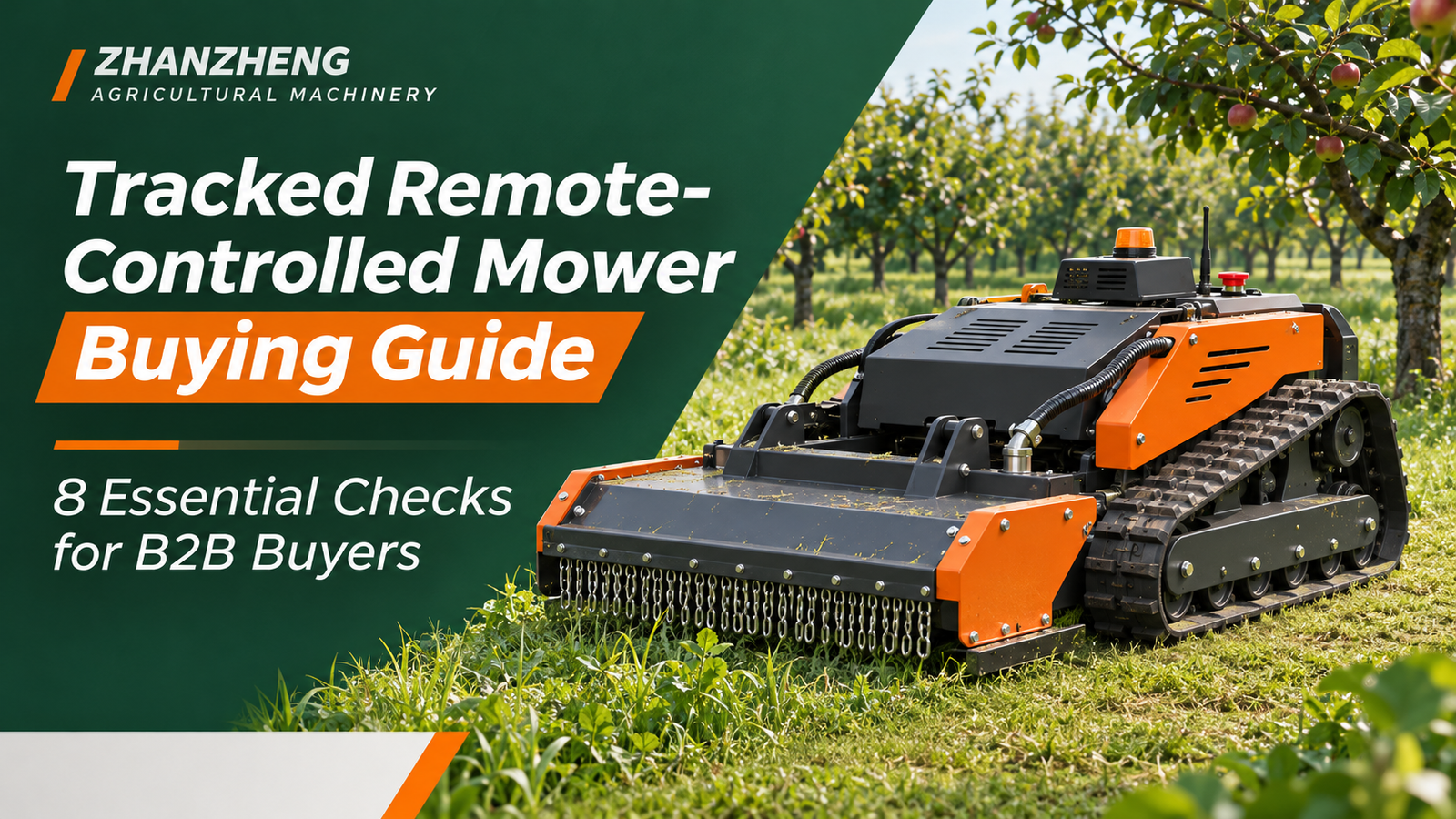
Remote-controlled mowers are becoming an equipment option for vegetation management in locations where conventional mowing machines may be difficult to operate.
For agricultural equipment importers, distributors, landscaping contractors and grounds maintenance buyers, selecting the right tracked remote-controlled mower requires more than comparing appearance, engine specifications or price.
Cutting width, machine dimensions, ground conditions, remote-control functions, safety systems and spare-parts availability can all influence whether a mower is suitable for a particular job.
This guide covers eight important checks to make before purchasing a tracked remote-controlled mower, with a practical example based on the ZHANZHENG 188-001 model.
1. Understand the Main Applications
Before comparing mower specifications, identify the environment where the machine will operate.
Typical applications considered by buyers of remote-controlled mowing equipment include:
- Orchard and plantation vegetation management.
- Grass cutting around agricultural facilities.
- Grounds maintenance and landscaping.
- Vegetation management in areas with limited access.
- Selected uneven or sloped sites, subject to the machine's approved operating limits.
Different sites require different machine configurations.
For example, an orchard may have narrow rows, low branches and irrigation equipment, while an open grass area may offer more turning space.
Buying tip: Share photographs, vegetation descriptions, access measurements and ground conditions with the equipment supplier before choosing a model.
2. Check Terrain and Slope Suitability
Terrain compatibility is one of the most important considerations when evaluating a tracked remote-controlled mower.
Although tracked machines can offer traction advantages in some conditions, tracks alone do not guarantee safe operation on steep slopes or wet ground.
Several factors influence machine stability and control:
- Actual slope gradient.
- Ground firmness and moisture.
- Surface obstacles and uneven terrain.
- Vegetation conditions.
- Machine weight distribution.
- Travel direction and turning requirements.
Does a Tracked Mower Work on Every Slope?
No.
Each machine has its own operating limits.
A mower designed for relatively level ground should not automatically be considered suitable for steep embankments simply because it has tracks and a remote controller.
Operators must follow the approved slope limits and operating instructions for the specific machine.
Wet surfaces, loose soil and changing terrain conditions may reduce traction and increase operating risks.
Important: Before ordering a mower for slope maintenance, request the model-specific operating limits and safety documentation. Do not assume a slope rating that has not been verified.
3. Compare Cutting Width and Machine Dimensions
Cutting width is often one of the first specifications buyers examine.
It represents the nominal width of the mower's cutting path.
A larger cutting width may reduce the number of passes required for a given area, but actual productivity depends on vegetation, travel speed, overlap, terrain and operating conditions.
Cutting Width Is Not Overall Machine Width
These two measurements should never be confused.
Cutting width describes the nominal cutting path.
Overall width describes the machine's physical width, including its chassis and other relevant components.
For orchard and plantation applications, overall width can be particularly important because equipment must pass between rows, posts, gates and other obstacles.
A machine with a 560 mm cutting width may be considerably wider than 560 mm overall.
Buyers should measure the narrowest access point and compare it with the machine's complete dimensions, allowing for safe operating clearance.
4. Understand the Engine and Travel Drive System
Remote-controlled mowers may use different power architectures.
Depending on the model, equipment may be engine-powered, battery-powered or use a combination of engine and electric systems.
It is important to understand which components receive power from each system.
Engine-Powered Mowing Systems
Some machines use an engine to provide power for mowing operations.
The engine designation alone does not confirm horsepower, fuel consumption or actual cutting performance.
Buyers should request the complete engine specification and operating documentation.
Electric Travel Motors
A machine may use electric motors to drive its tracks or wheels while using an engine for other functions.
In this arrangement, the travel motor rating must not be mistaken for the engine's cutting power.
When comparing models, ask which power system operates the cutting mechanism, which drives the tracks and how onboard electrical power is supplied.
5. Review Remote-Control Functions and Safety
Remote control allows an operator to direct the mower from a position separate from the machine.
However, remote-controlled mowing is not the same as fully autonomous mowing.
Unless a particular machine is specifically equipped and approved for autonomous operation, an operator must remain responsible for controlling and supervising it.
Remote-Control Range
Manufacturers and catalogues may list a maximum remote-control distance.
This figure should not automatically be treated as a guaranteed practical operating distance.
Trees, buildings, terrain, interference and the selected controller can affect communication.
The operator should follow the manufacturer's instructions, maintain the required visibility and never operate beyond the approved control limits.
Safety Features to Check
Before purchasing, ask about:
- Emergency-stop functions.
- Braking and stopping behaviour.
- Remote-signal loss response.
- Blade guarding and protective covers.
- Warning indicators and operator instructions.
- Safe operating distances for people and animals.
- Approved slope and terrain limits.
Remote operation does not remove hazards from moving blades, thrown debris or machine instability.
A site-specific risk assessment and suitable operator training remain essential.
6. Product Example: ZHANZHENG 188-001 Tracked Remote-Controlled Mower
The ZHANZHENG 188-001 is a tracked remote-controlled mower available for evaluation by agricultural machinery buyers and equipment distributors.
Its available catalogue specifications include:
| Specification | Catalogue Information |
|---|---|
| Model | 188-001 |
| Equipment type | Tracked remote-controlled mower |
| Engine designation | Yuchai 188 |
| Travel motors | 2 × 24 V / 800 W |
| Mowing width | 560 mm |
| Listed remaining-grass height | 50–60 mm |
| Approximate overall dimensions | 1,300 × 990 × 700 mm |
| Catalogue weight | 240 kg |
| Control method | Radio remote control |
| Listed remote-control range | Up to 500 m |
These figures should be treated as catalogue information rather than independently verified operating performance.
What Do These Specifications Mean for Buyers?
560 mm mowing width
This is the listed cutting width, not the overall machine width.
Yuchai 188 engine
This identifies the listed engine designation. Buyers should confirm the final engine specifications and fuel requirements.
Two 24 V / 800 W travel motors
These are the listed travel-drive motor specifications and should not be advertised as the mowing engine's power rating.
Up to 500 m remote-control range
This is a catalogue-listed maximum. Actual operating distance depends on the site, controller and manufacturer-approved operating conditions.
240 kg catalogue weight
This should not be assumed to equal the final packed shipping weight.
Is the 188-001 Suitable for Your Site?
Suitability depends on the exact working conditions and the supplied machine configuration.
Before ordering, confirm terrain limits, vegetation requirements, control functions, safety documentation and transport arrangements.
View the product: 188-001 Tracked Remote-Controlled Mower
Explore the range: ZHANZHENG Remote-Controlled Mowers
7. Consider Maintenance and Spare Parts
For overseas buyers, long-term maintenance support can be as important as the initial purchase price.
Remote-controlled mowers combine mechanical, electrical and cutting components that may require different maintenance procedures.
Before ordering, ask about:
- Replacement cutting blades and related components.
- Track maintenance and replacement.
- Engine service requirements.
- Electrical system and controller servicing.
- Routine inspection procedures.
- Operating and maintenance manuals.
- Availability of replacement parts.
For distributors, a clear spare-parts plan can help support local customers after the initial equipment sale.
Do not assume spare parts are interchangeable between different mower models.
8. Prepare a Complete Import Purchase Checklist
When purchasing remote-controlled mowers internationally, buyers should request accurate information about the complete delivered equipment.
| Item | What to Confirm |
|---|---|
| Model | Exact model and configuration |
| Working environment | Terrain, slope, vegetation and access conditions |
| Engine | Model, power specification and fuel requirements |
| Cutting system | Width, cutting mechanism and approved operating conditions |
| Remote control | Controller functions, range limitations and emergency stopping |
| Safety | Operating manual, guards and applicable safety requirements |
| Logistics | Packing method, package dimensions and shipping weight |
| After-sales | Spare parts, maintenance instructions and warranty terms |
| Commercial terms | Quantity, price, lead time and delivery terms |
Importers should also verify any applicable machinery, emissions, conformity and documentation requirements in their destination markets.
These requirements vary by country and should not be assumed from the equipment's appearance or general product category.
9. Frequently Asked Questions
What is the difference between a tracked mower and a wheeled mower?
Tracked and wheeled machines use different ground-contact and travel systems. Their suitability depends on terrain, traction, manoeuvrability, ground conditions and maintenance requirements. Neither design is automatically the best choice for every application.
Can a remote-controlled mower operate on steep slopes?
Some specialized remote-controlled mowers are designed for slope operations, but each model has specific operating limits. The approved slope rating and relevant safety instructions must be confirmed before use.
Is a remote-controlled mower fully autonomous?
Not necessarily. A remote-controlled mower is normally operated by a person using a controller. Fully autonomous operation requires additional functions and must be explicitly supported by the specific machine.
How wide is the ZHANZHENG 188-001 mower?
The 188-001 has a listed mowing width of 560 mm. Its approximate overall machine width is 990 mm according to the available catalogue. Buyers should confirm final dimensions and clearance requirements.
How far can the 188-001 remote control operate?
The catalogue lists a remote-control range of up to 500 m. This is not a guaranteed range in all conditions. Actual operation must follow the specific controller instructions and applicable safety limits.
What information should I provide when requesting a quotation?
Provide the intended application, vegetation type, site photographs, access dimensions, slope and ground conditions, required quantity and destination country. Include any specific controller, safety or spare-parts requirements.
10. Final Thoughts
Choosing a tracked remote-controlled mower requires careful evaluation of more than cutting width or engine designation.
The best equipment choice depends on the terrain, vegetation, access conditions, machine dimensions, power configuration, safety systems and maintenance needs.
For international importers and distributors, accurate documentation and confirmed equipment specifications are essential for selecting the right product for local customers.
Before making a purchase, compare actual operating requirements with the selected machine's approved specifications.
Looking for remote-controlled mowing equipment?
Explore ZHANZHENG Remote-Controlled Mowers or contact ZHANZHENG with your equipment requirements to discuss available configurations and request a quotation.
Further Reading
- British Association of Landscape Industries — Safety Guide for Remote-Controlled Mowers on Slopes
- OSHA — Dangers of Roll-Overs of Riding Mowers
These resources provide general machinery safety context. They do not establish operating limits or safety certification for the ZHANZHENG 188-001.